I finally committed to investing more in this hobby: That means, i bought a camera and lenses (more information below) plus today I bought an editing software and a real plan and domain for this blog.
I also now finished writing about all my vacation experiences and am ready to share my first “good” pictures (of german wildlife, that i shot mostly on weekends). To fully finish up to real time now, I will group all those reamaining pictures to location and not date of shooting and will publish those over the next few days. My long term plan as of right now is to publish more frequently. I really enjoy going out with the new camera and think about composition, all the settings,…so I imagine, there is much to follow!
Taking me to this decision took a long process. The main step was to make an investment into fot-gear – the camera and the lenses. During this process I learned a lot through research, which I wanna share with you:
I decided to buy a decent APSC camera and a good lens. I got them in August just after my Canada trip – if you read everything, u understand why 😀 especially if you look at the phone photos.
I decided to go sony, because they seemed to be a little bit less expensive for what I wanted. Plus from them i could get a setup that i really liked.
First of all I decided to go APSC, because it gets me closer and get more effective focal length, which seemed to me most important in the beginning. In most of my earlier phone photos the distance was the main problem that i had. So i wanted to get as much distance for as little money that i could. That meant APSC and either the 70-350 APSC lens or the 200-600. The second one being more expensive (ca. 700€ vs 1500€ in Germany). I did some research and decided not wanting to pay 1500€ for the lens. For camera bodies I liked the a6400 and the a6700. The 6400 has everything i need, i just wasnt sure if i need some more Megapixels and the OBIS from the a6700. Plus the 6700 was newer with better menu and better autofocus. This plus the tipps below were basically my thought process, which lead me to the following choice.
I got lucky and found a good offer for the 70-350 plus a6700 and decided to buy that, and im still glad I did. Writing this just around black friday, its a little cheaper now. But I bought it for 1850€ new which was ok for me and I already used it A LOT.
In hinesight I should have rented first just to be safe, but the research got me hungry for the images I saw on research.
Afterwards i went out so much that I actually decided to buy the 200-600 too 😀 Bought that for 1475€ in Oktober, also new. And Im also still glad i did. I got a lot of nice photos that you will see over the next days and am all in all very happy with those choices. Im even thinking of buying another more expensive lense – its getting hard to withstand better image quality from the prime lenses.
Why not sell the 70-350? I wont ever i think. More on that in the following tipps for deciding what camera and lens to buy. Important note: Those are informations i gathered from researching and experiences of wildlife shooting experts on youtube 😀 All in all I feal safe to share this for hobbyists but be careful – im no expert and those are basically my opinions and not everything is based on solid research. The tipps are in order of importance to me personally.
1.) Rent first!!! Thats cheap and if you wanna try a lot of different stuff, this gets u far. I got lucky that im glad with my choices but i definetly should have rented first to be sure.
2.) Try to make a budget if possible. That can help – i didnt do it though 😀
3.) Think about what u wanna shoot and do research! Since u are reading this blog I guess u are into wildlife as well. That means u need to decide between close up macro (frogs, insects,…), generally bigger animals or small birds. All of those have different focal lengths that would be better. I did some calculations:
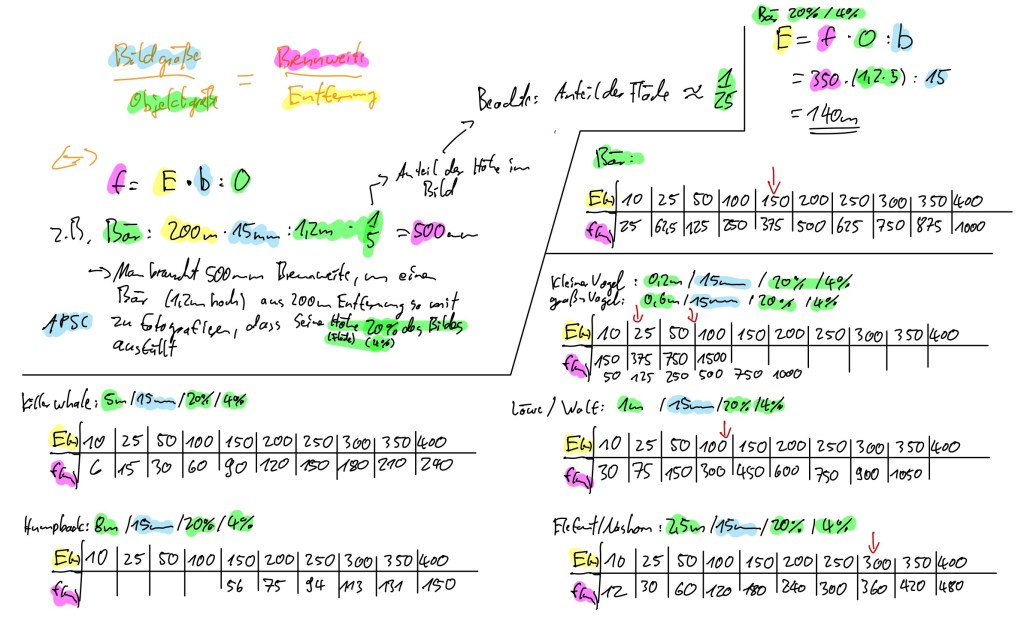
(should be accurate but I didnt double check)
Summarizing: specific macro lenses for macro; and at least 600mm for small birds. I dont wanna limit that more, because there are more factors that influence the focal length: For example: How close can u get to the target? The close the less focal length needed. How much megapixel does your camera have? The more MP, the more you can crop the image, thus “get closer”. Which format are u shooting? If you shoot smaller format than fullframe, for example APSC, then your images are smaller and thus closer to the target (most fullframe cameras now have an APSC mode. For example the 61MP R5 from sony has i think 26MP in APSC mode, which makes it distance-wise equivalent to the a6700).
This also means, u need to decide if you wanna do mostly photo, mostly video, both photo and video, or not decide yet. Your camera body decision might depend on that, plus in filming the zoom option is important, which of course requires u to get a zoom lens then.
4.) Look for the lense first, and then the camera. Also lense options are important too. For example only canon offers a 200-800, and sony does not yet.
5.) Decide if you want zoom or not. In wildlife shooting there are multiple reasons to prefer zoom. For fast and expecially smaller animals like birds u can zoom out to find the animal and then zoom in on it – BUT: I read with experience this gets less important. With zoom u also are more flexible if animals come closer to you. On the other hand the zoom option in general makes the lense heavier (see below for weight). Also non zoom lenses are supposed to be sharper, but i dont know why or if that is true. If you decide for zoom then watch out if the lense has external (it pops out) or internal zoom. Internal has the advantage of mostly having to do less turning to zoom, you can stay steadier when zooming (especially important for filming), and its more dust/water sealed. On the other hand most external zooms are less heavy and less expensive i think.
6.) Decide the minimum aperture you need. This depends on the time and wheather conditions. If they are mostly bad, then you need a low aperture. If not or its mixed, then this might not be of that much importance. But still: The lower the minimum aperture of a lense, the better low light performance. This also depends a lot on your budget, since lower aperture lenses mostly are very expensive, if you dont wanna trade it for reach.
7.) Weight: You might think this isnt important because you are strong or whatever 😀 But trust me it can definetly matter a lot. First of all u need to think if you see yourself only handholding, mostly with monopod/tripod (which doesnt mean that u have to stay at one spot!), or being flexible and open for both. If you see yourself not mattering a monopod or tripod in general, then weight shouldnt matter to you. If you know that you will also have the option to use natural pod (stone, wall, wood) then u should also be fine, not mattering the weight. If you arent sure yet or if you can definetly exclude tripods/monopods, then you should test it (e.g. by renting) what u are comfortable holding. I myself are fine holding the 200-600. To be more precise: Im fine holding it with screwed on handle+ peak design strap attached+a6700 body (approximately 3.1kg) in my hands for 2-3min at a time. I always drop it down and let the strap and my shoulder take the weight whenever i can. But I myself plan to do more workout to be sturdier. Plus I expect when my energy runs out i tend to not being able to hold the lens steady with messes with the image sharpness of course.
Also i myself find: Less weight, more fun: You are just more flexible and it feels more relaxed. Directly comparing the 70-350 with the 200-600 shooting with the 70-350 makes more fun because of that. On the other hand the weight of the 200-600 (plus a little bit its optics and price) makes it feel more quality and makes yourself kind of feel more professional 😀
8.) Appearence: This might be situational but i wanna share this since I find it influences me: When I go out with my black and short (exspecially when zoomed out) 70-350 i wont really get looked at from people. That is because the color black blend more in in general, and the length/size doesent seem to attract attention. When I go out with the 200-600 on my strap I definetly feel looks of people which annoys me – but that might be a personal thing. The lens just stands out with its white color and size. I even find myself waiting till im out of sight to get my camera out of my backpack. And in some cases that made me miss some shots. I dont think this should influence your decision very much but I recommend thinking about locations where u wanna shoot and how many people there are. Plus: If you have a partner that you like to go to places where u might wanna also shoot – If they dont share ur hobby (yet), then they dont usually wanna walk around with some bird nerd besides them. Trust me, my girlfriend has less problems with me when i carry the 70-350 than when i carry the 200-600.
9.) Length: The length of the lens should imo influence your backpack choice and not the other way around. But if you shoot often from cars for example, this might be a problem. Also if you fly you might have to consider carry on restrictions. The length should in most cases not be an issue though.
I hope these tipps, that i collected are helpfull to you. Having some experience now, i definetly see advantages of weight and minimum aperture now, which i didnt see, when I bought my equipment. One more reason to rent first!
 Wildlife View Blog
Leave a comment